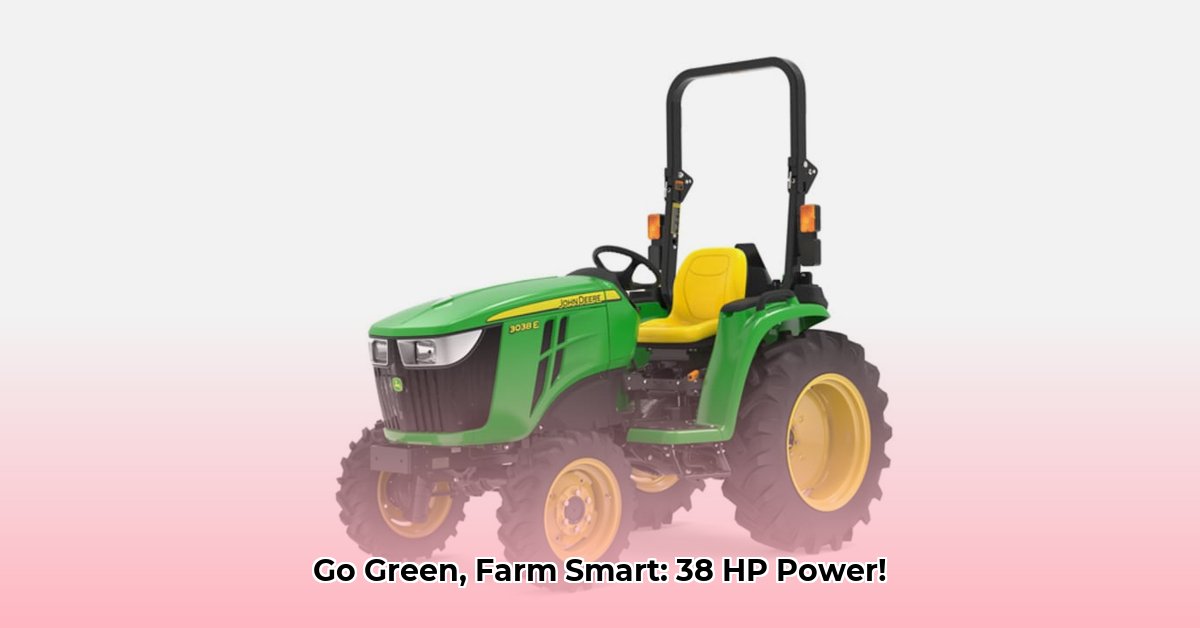
The John Deere 3038E compact tractor offers a compelling blend of power, efficiency, and sustainability, making it a strong contender for modern farming operations. This in-depth analysis examines its key features, performance capabilities, and overall suitability for diverse agricultural applications. We'll delve into its engine technology, safety features, maintenance requirements, and cost implications, providing a comprehensive assessment for potential buyers. For more information on John Deere tractors, visit John Deere Tractors.
Engine Technology and Sustainability: Powering a Greener Future
The John Deere 3038E is powered by a Yanmar engine, renowned for its reliability. However, it's the advanced emission control technology that truly distinguishes this tractor. The common rail system (CRS) ensures precise fuel injection for optimal combustion, resulting in improved fuel efficiency. Furthermore, a sophisticated after-treatment system, incorporating a diesel particulate filter (DPF) and a diesel oxidation catalyst (DOC), significantly reduces harmful emissions. This translates to cleaner air and a smaller carbon footprint, aligning perfectly with the goals of sustainable agriculture. While precise fuel consumption comparisons against its predecessors require further investigation, the technological advancements promise significant savings. Does this mean lower operational costs and a smaller environmental impact? The data suggests a definite possibility.
Operator Comfort and Safety Features: Prioritizing Wellbeing and Productivity
Extended periods of operation demand a comfortable and safe working environment. The John Deere 3038E addresses this with an ergonomically designed operator station and intuitive controls, including Twin Touch™ foot pedals and optional cruise control, aiming to reduce operator fatigue and enhance productivity. Crucially, the tractor incorporates safety features like a Roll-Over Protective Structure (ROPS) and an operator presence system, automatically shutting down the engine if the operator leaves the seat. These features ensure a safer and more efficient working experience. How does this translate to actual gains in farm output? Further research is needed for precise quantification, but the potential for increased efficiency is undeniable.
Maintenance and Long-Term Costs: A Balanced Perspective
While the 3038E is designed for relatively straightforward maintenance, it's vital to understand the long-term financial considerations. The advanced after-treatment system, while environmentally beneficial, necessitates periodic maintenance, including DPF ash removal. The frequency and cost of this maintenance depend heavily on usage patterns and operating conditions. Therefore, obtaining detailed cost projections from John Deere dealers is crucial for accurate budgetary planning. A thorough cost-benefit analysis is vital, considering factors like fuel savings and potential repair costs to properly assess the long-term economic viability of the 3038E.
Scalability and Applicability: Matching Tractor to Task
The John Deere 3038E's classification as a compact utility tractor dictates its suitability for various farming applications. It excels in smaller-scale operations, community gardens, and specialized tasks. However, its horsepower rating limits its applicability for extensive large-scale field work. Farmers should carefully assess their operational needs and farm size to determine if the tractor's capabilities align with their requirements. The 3038E's versatility makes it a strong candidate for diverse farms, but a careful evaluation of specific needs ensures optimal utility.
Comparative Analysis: Benchmarking the 3038E
A comprehensive market analysis comparing the John Deere 3038E's fuel efficiency, cost of ownership, and overall performance against competing models is crucial for informed decision-making. This comparative data, currently lacking, would allow for a more nuanced understanding of the 3038E's positioning within the compact tractor market. Further research will be essential in providing such an analysis.
Conclusion: Sustainable Farming, Data-Driven Decisions
The John Deere 3038E represents a significant advancement in sustainable agricultural technology. The improvements in fuel efficiency, emission reduction, and enhanced operator comfort contribute to both environmental responsibility and increased productivity. However, a comprehensive cost analysis, incorporating all maintenance aspects and factoring in operational scale, is imperative for informed purchasing decisions. Further research is essential to fully understand the 3038E's long-term economic viability and suitability across diverse farming contexts. This analysis provides a solid foundation, yet more detailed data is crucial for a definitive assessment.